I have been engaged in continuous research and practice in astrology for over
35 years. From the earliest phase of my formal study, I observed a
fundamental problem within classical astrological literature: multiple, often
contradictory formulas are prescribed to determine the same event, particularly
in timing techniques. In many cases, different methods applied to the same horoscope
yield different results for the same event. An event, however, can occur only once;
it cannot have multiple correct timings.
This contradiction became the starting point of my research. If astrology is to be
regarded as a science, it must function with complete internal consistency.
A system that succeeds in 99% of cases but fails in 1% cannot be considered scientific.
In any objective system, two plus two will always equal four, without exception.
After decades of systematic case studies, rectifications, and long-term observational
analysis, I have developed techniques that, when applied correctly, do not fail.
These include original frameworks such as Bhattacharjee Ayanamsa,
JeevaBindu, and other precision-oriented predictive methods derived
through empirical validation.
Astrology is not a commercial activity for me. It is a discipline of knowledge and
a sacred science. My objective is not to preserve tradition for its own sake, but to
remove ambiguity, eliminate contradiction, and restore logical and mathematical
coherence so that astrology can operate as a truly predictive science.
House Division in Vedic Astrology: Classical Rules vs. Modern Misunderstandings
A Definitive Guide Based on Classical Texts
Author: Subhamoy Bhattacharjee, 06/12/2025
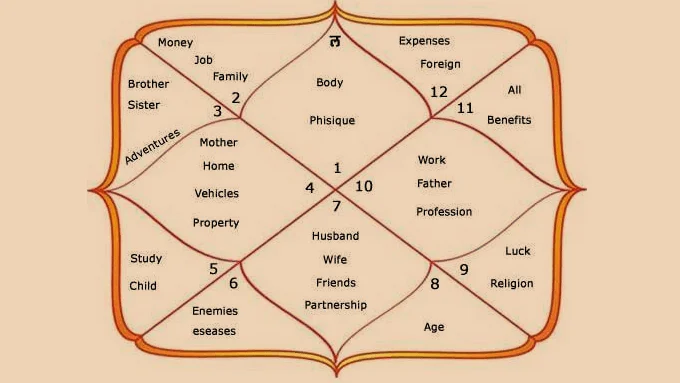
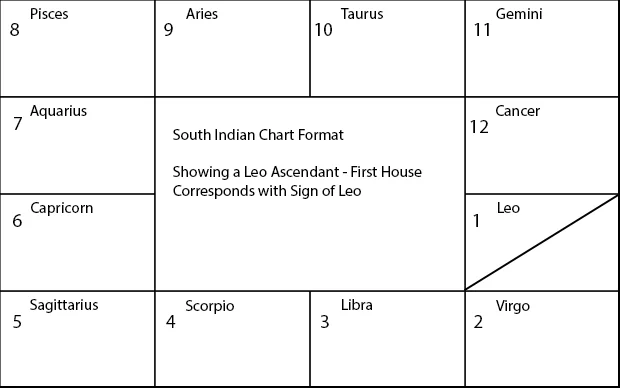
The 12 Houses in Vedic Astrology – Whole Sign System OverviewSouth Indian Vedic Rasi Chart Format – Houses as Whole Signs
Introduction
Among students and practitioners of astrology, one of the most common confusions is the meaning of “houses” (bhāvas) in Vedic or Hindu astrology. Modern astrologers often mix Western house systems — Placidus, Equal House, Porphyry, Koch — with Vedic concepts. This creates mathematical and interpretive contradictions.
To resolve this, we examine the actual classical definitions of houses found in Bṛhat Parāśara Horā Śāstra, Jaimini Sutras, Saravali, Phaladeepika, and traditional commentaries.
The conclusion is simple, unambiguous, and foundational.
The Classical Vedic Definition of a House
The Key Rule
The sign in which the Ascendant degree falls is the First House. The next sign is the Second House. The next sign is the Third House. And so on, until all 12 houses are assigned one full sign each.
This is called the Whole Sign House System, and it is the only system used in all classical Vedic texts.
3. Classical Text References
3.1 Bṛhat Parāśara Horā Śāstra (BPHS)
Parāśara repeatedly defines bhāvas through rāśis (signs), not degrees. Examples:
When describing bhāva lords, Parāśara states: “The lord of the sign occupied by house X…” — implying house = sign.
No shloka defines houses by degree-based cusps.
3.2 Jaimini Sutras
Jaimini uses only signs for:
Karakas
Argalas
Rashi drishti
Chara dasa
Bhava evaluation
There is never any reference to degree-based house boundaries.
3.3 Saravali (Kalyana Varma)
Saravali interprets bhāvas strictly by signs. All examples assume:
House = sign
A planet “in the 4th house” means “in the 4th sign from the Lagna.”
Nowhere do these texts mention Western-style cusps or degree divisions.
4. The Common Modern Misunderstanding
Many modern Vedic astrologers claim:
“Take the midpoint between the 1st and 2nd house cusps to define House 1.”
This idea does not belong to Vedic astrology.
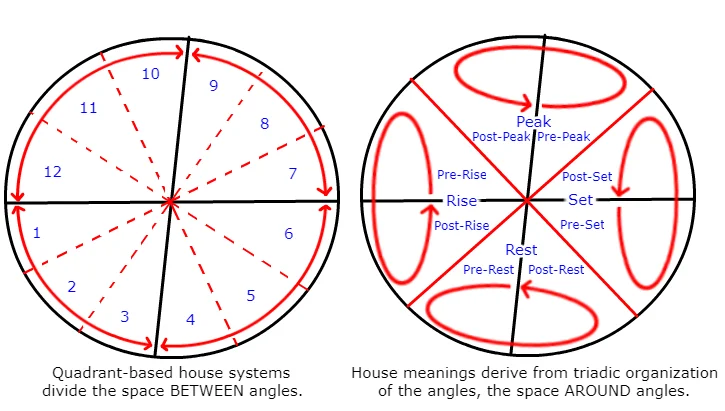
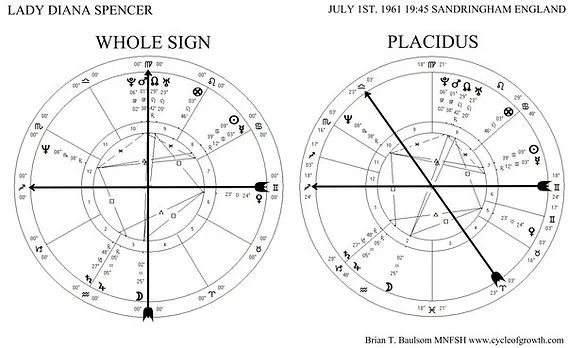
Comparison of House Systems: Whole Sign vs. Placidus vs. OthersWhole Sign vs. Placidus House Systems
4.1 What system is this?
This corresponds to a Western cusp-to-cusp house system, most commonly:
Equal House System (Asc-degree-based)
Sometimes Porphyry
Sometimes Placidus (where midpoints define house centers)
These systems assume:
Houses span from one degree-based cusp to the next
The midpoint is the center of a house
4.2 Why this is not Vedic
Because classical Indian astrology:
Never defines houses by cusps
Never uses midpoints
Never uses degree-based boundaries
Uses only signs for bhāva interpretation
Mixing Western cusps with Vedic rules breaks:
Lordships
Yogas
Dashā predictions
Arudha computation
Varga (divisional) charts
Jaimini methods
BCP (Bhrigu Chakra Paddhati)
In short, it dismantles the entire Vedic framework.
5. Why Whole Sign is the Only Logical Vedic System
5.1 Bhava Lords
Every bhava uses the sign lord, not the cusp lord. This is impossible if a house straddles two signs.
5.2 Yogas
Yogas operate based on sign positions, not degrees or cusps.
Example: Gajakesari Yoga requires Moon and Jupiter to be in Kendra signs, not “Kendra degrees.”
5.3 Divisional Charts
All vargas (D9, D10, D60) are sign-based. Using cusps destroys their logic completely.
5.4 Jaimini
Jaimini rashi drishti, chara karakas, and dasās depend only on signs.
5.5 BCP (Bhrigu Chakra Paddhati)
BCP uses 1 year per sign, not “1 year per degree-house.”
Whole Sign is the skeleton of Vedic astrology.
6. Summary and Final Clarity
Vedic Rule (Classical and Correct)
✔ The sign containing the Ascendant = 1st House ✔ The next sign = 2nd House ✔ The next sign = 3rd House ✔ Continue through all 12 signs.
Not Vedic (Modern Misunderstandings)
❌ Midpoint-to-midpoint house systems ❌ Placidus ❌ Koch ❌ Porphyry ❌ Degree-based Equal House ❌ Western-style cusps
Name of midpoint-based system
✔ It is a Western cusp-to-cusp house system, usually the Equal House System (Asc-degree-based) or Porphyry.
7. Conclusion
The confusion about house systems arises because modern astrologers mix Western and Vedic techniques. Classical Vedic astrology, as preserved in Sanskrit texts, uses only Whole Sign Houses, where each sign is a complete bhāva starting from the sign of the Lagna.
Once this foundational truth is accepted, the entire system becomes clear, consistent, and predictive.