I have been engaged in continuous research and practice in astrology for over
35 years. From the earliest phase of my formal study, I observed a
fundamental problem within classical astrological literature: multiple, often
contradictory formulas are prescribed to determine the same event, particularly
in timing techniques. In many cases, different methods applied to the same horoscope
yield different results for the same event. An event, however, can occur only once;
it cannot have multiple correct timings.
This contradiction became the starting point of my research. If astrology is to be
regarded as a science, it must function with complete internal consistency.
A system that succeeds in 99% of cases but fails in 1% cannot be considered scientific.
In any objective system, two plus two will always equal four, without exception.
After decades of systematic case studies, rectifications, and long-term observational
analysis, I have developed techniques that, when applied correctly, do not fail.
These include original frameworks such as Bhattacharjee Ayanamsa,
JeevaBindu, and other precision-oriented predictive methods derived
through empirical validation.
Astrology is not a commercial activity for me. It is a discipline of knowledge and
a sacred science. My objective is not to preserve tradition for its own sake, but to
remove ambiguity, eliminate contradiction, and restore logical and mathematical
coherence so that astrology can operate as a truly predictive science.
Why Astrology Misunderstands Influence: A Dynamic Theory Based on Motion, Change, and Planetary Capacity
(Thirty Years of Continuous Observation)
Abstract
Astrology traditionally evaluates planetary influence using static factors such as sign placement, dignity, lordship, yogas, and fixed relationships. However, decades of direct observation reveal a persistent contradiction: planets that are "strong" by position often remain experientially silent, while planets in motion dominate entire phases of life. This article proposes a dynamic theory of astrological influence, asserting that influence is generated primarily by change, motion, and approach, not by permanence. Furthermore, influence is not symmetric; it depends on the capacity of a planet to dominate, amplify, or transform another. The strongest astrological effects arise when two planets move toward each other and one possesses greater influence capacity. This framework offers a correction to position-centric astrology and provides a more realistic explanation of lived experience.
1. The Human Clue Astrology Overlooked
Human life itself reveals the governing rule of influence.
A person born healthy rarely thinks about health.
A person born wealthy does not experience wealth as pressure.
A person born poor adapts to poverty; it becomes background.
But the moment these conditions change, they dominate life:
Illness overwhelms the previously healthy.
Sudden wealth reshapes identity and behavior.
Loss devastates those who never knew lack.
The state itself is not influential.
The transition is.
This principle holds across psychology, economics, biology, and social behavior. Any system claiming to describe lived experience must obey it. Astrology is no exception.
2. The Core Limitation of Static Astrology
Most astrological "influencers" are fixed at birth:
Sign lordship
Exaltation and debilitation
Trines and yogas
Natural friendships
Nakshatra ownership
These factors do not change with time.
As a result, they describe:
potential,
capacity,
background structure.
They do not explain:
why certain years dominate life,
why specific phases feel overwhelming,
why an otherwise "weak" planet suddenly takes control.
Static conditions define what is possible.
They do not explain what is experienced.
Experience requires change.
3. The Necessary Shift: From Position to Motion
The fundamental correction is simple:
Astrological influence is not positional.
It is dynamic.
What matters most is not where a planet is placed, but what it is moving toward.
This immediately elevates:
applying conjunctions,
applying aspects,
converging planetary motion,
and reduces the predictive weight of:
permanent dignity,
static yogas,
birth-only strengths.
Life unfolds in time, not in diagrams.
4. Applying Motion: How Influence Is Activated
When planet P1 moves toward planet P2:
the angular distance decreases,
the future interaction becomes inevitable,
psychological and experiential pressure increases.
This influence is:
gradual,
cumulative,
accelerating.
It is not binary.
Separating planets rapidly lose relevance.
Static planets fade into background noise. Applying planets dominate attention and outcome.
This mirrors reality: anticipation and pressure increase as events approach, not when they are static.
5. A Crucial Correction: Influence Is Not Symmetric
It is tempting to assume:
"If two planets move toward each other, both influence each other equally."
This assumption is false.
Motion alone activates influence, but it does not decide direction.
Direction depends on planetary capacity.
Defining Influence Capacity
In this framework, Influence Capacity refers to a planet’s
observed ability to dominate, absorb, redirect, or override the functional
expression of another planet during periods of close application.
This capacity is not inferred from mythology, traditional hierarchy,
or textual authority, but is derived from repeated
outcome-based observation across charts and timelines.
A planet with high influence capacity retains its functional nature even when
approached by other planets, while planets with low influence capacity
primarily respond, reflect, or transmit influence rather than generate it.
Influence capacity therefore determines the direction of influence,
not merely its presence.
Influence is activated by motion,
but its direction is fixed by capacity.
6. Case Study: Moon and Rahu Approaching Each Other
Consider a simple but revealing example:
Moon and Rahu are moving toward conjunction.
Both are in motion.
Both are approaching.
Now ask the only question that matters:
Who influences whom?
Nature-Based Analysis (not textual, not mythological)
Moon
Has no independent light
Reflective and reactive
Emotionally adaptive
Rapidly changing
Lacks the structural capacity to dominate or transform other planets
Rahu
Amplifying and consuming
Slow and persistent
Distorts perception
Intensifies obsession and fixation
Alters the functioning of planets it contacts
Observed Outcome
As Moon approaches Rahu:
emotional instability increases,
obsession and confusion intensify,
mental turbulence dominates experience.
But Rahu:
does not become emotional,
does not lose coherence,
does not adopt lunar qualities.
Conclusion:
The Moon undergoes significant functional modification as it approaches Rahu.
Rahu, however, retains its structural nature and does not undergo reciprocal change.
Although motion exists on both sides, influence remains unidirectional
due to asymmetry in influence capacity.
The Moon lacks the structural capacity to modify or dominate Rahu; instead,
it becomes the medium through which Rahu’s amplifying and distorting influence
is expressed. This asymmetry is consistently observable in outcome-based analysis.
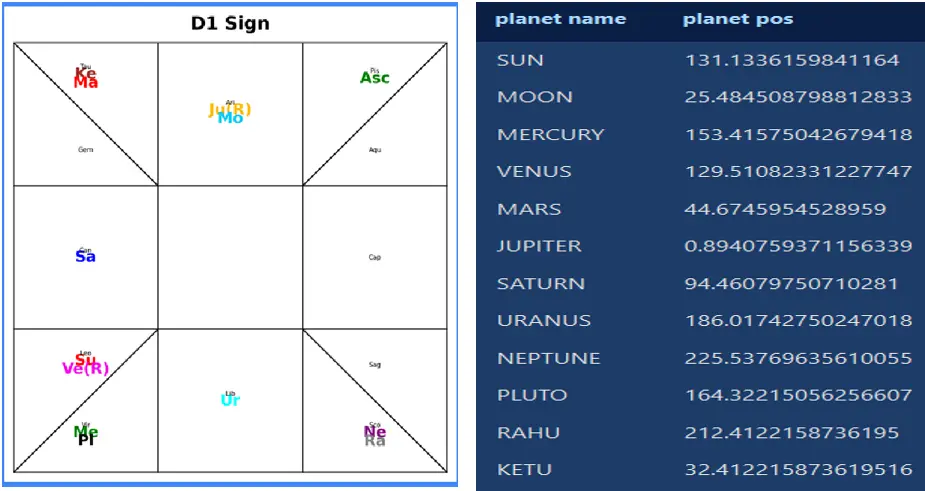
13. Applied Examples: Dynamic Influence in Real Horoscopes
Visual representation of dynamic influence theory showing planetary motion, capacity hierarchy, and influence flow
Example 1: Mars Approaching Saturn
Income Becoming Expense through an Unavoidable Convergence
Mars is the lord of the 2nd house (wealth) and 9th house, functioning as 11th from the 11th, reinforcing its role as a finance and income significator.
Mars is applying toward Saturn.
Saturn is the lord of the 11th (income) and 12th (expense) and is placed in the 5th house.
Dynamic Interpretation
Mars represents money flow and earning potential.
Saturn represents both income and loss, but with stronger emphasis on constraint and outflow due to its 12th lordship.
Because Saturn has higher influence capacity than Mars:
Mars cannot strengthen Saturn
Saturn absorbs and redirects Mars's financial energy
Outcome
Income does occur (11th lord Saturn), but it is neutralized by expense (12th lord Saturn).
Example 2: Mercury Approaching Pluto and Rahu
Multiplicity in Relationships and Explosive Creative Thought
Mercury is the lord of the 4th and 7th houses.
Mercury is placed in the 7th house, directly representing life partner and relationships.
Mercury is applying first to Pluto and then to Rahu.
Mercury also aspects the Ascendant, directly influencing personality.
Dynamic Interpretation
Mercury is a low influence-capacity planet:
it reflects,
adapts,
multiplies,
communicates.
Pluto and Rahu both possess very high influence capacity:
Pluto intensifies, breaks, and regenerates
Rahu amplifies, multiplies, and destabilizes boundaries
Outcome in Relationships
Since Mercury is the 7th lord in the 7th, and it is being successively influenced by Pluto and Rahu, the result is:
multiple relationships,
more than one life partner or marriage-like involvement,
unstable or unconventional partnership patterns.
Mercury does not influence Rahu or Pluto. Instead, it becomes a carrier of their agenda.
14. Conclusion
Astrology becomes accurate when it aligns with how influence actually works.
Stability is silent.
Change is loud.
Motion creates pressure.
Capacity decides dominance.
The strongest astrological influence is not a planet, a sign, or a yoga.
It is the inevitable future state a planet is moving toward,
when that future has the power to dominate the present.
This theory, refined through thirty years of observation, offers a coherent, testable foundation for a truly dynamic astrology—one that explains not just charts, but life as it is experienced.
Author's Note:
This framework is derived from long-term observation of outcomes,
not from textual authority or inherited doctrine.