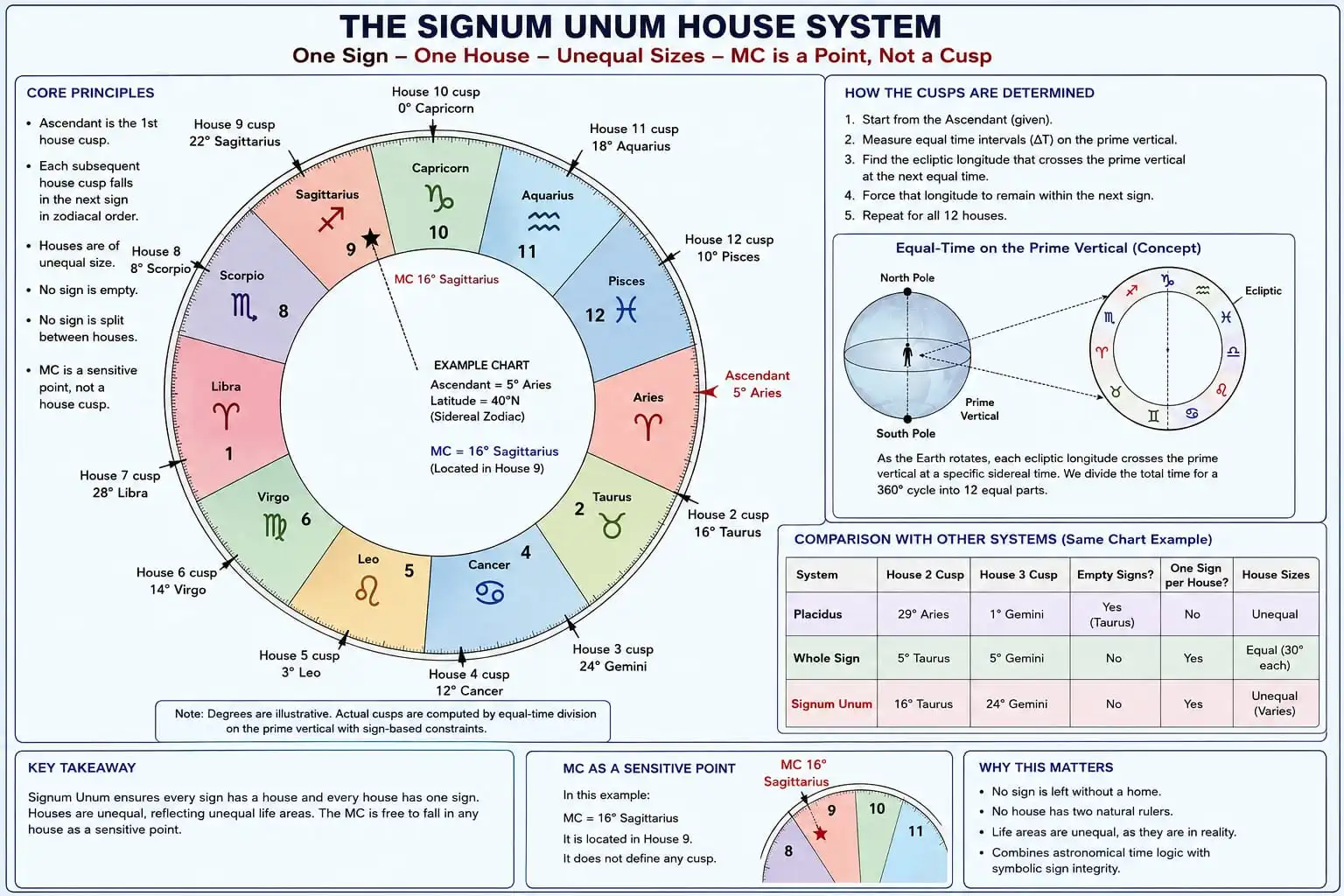
Title: The Signum Unum House Division System: A New Astrological House System
Author: Subhamoy Bhattacharjee
First Published: 8 May 2026
Original Publication: https://www.talk2destiny.co.in/signum
Copyright © 2026 Subhamoy Bhattacharjee
All Rights Reserved
All existing house division systems suffer from a fundamental dilemma: either houses are unequal in size but allow empty signs or a single sign to span multiple houses (Placidus, Campanus, Regiomontanus), or each sign is contained within a single house but houses are equal in size (Whole Sign, Equal House). This paper introduces the Signum Unum system, which resolves this dilemma by requiring that each of the 12 zodiacal signs corresponds to exactly one house, in order, while house sizes remain unequal. The system uses equal-time division on the prime vertical, with sign-based constraints. The Midheaven (MC) is treated as a sensitive point, not a house cusp. The system is mathematically deterministic, philosophically consistent, and computationally implementable.
Astrological house division attempts to map the local celestial sphere onto 12 discrete domains of human life. However, every existing system contains a flaw that this author considers unacceptable:
The Signum Unum system is built on a simple philosophical axiom:
One sign, one house, in order. House sizes unequal. MC is a point, not a cusp.
| System | House Size | One Sign per House? | Problem |
|---|---|---|---|
| Placidus | Unequal | No | Signs empty; houses split signs |
| Campanus | Unequal | No | Same |
| Regiomontanus | Unequal | No | Same |
| Koch | Unequal | No | Same |
| Equal House | Equal | Yes | All houses same size (unrealistic) |
| Whole Sign | Equal | Yes | Same |
| Meridian | Unequal | No | Incomplete; MC obsession |
The core tension is unsolvable in traditional systems because they all treat the MC as a house cusp (usually house 10). This forces a geometric constraint that conflicts with sign boundaries. The Signum Unum system breaks that tradition intentionally.
This system finally provides a mathematical proof for the "unequal limbs" theory. In Whole Sign, every "limb" is exactly 30 units. In Placidus, some people are born missing a "limb" (intercepted sign).
Signum Unum is the only system that guarantees:
Both are logically contradictory and astrologically harmful.
The Midheaven (MC) is the intersection of the meridian with the ecliptic. In traditional systems, it is forced to be the 10th house cusp. In Signum Unum:
The MC is a sensitive point, like a planet. It may fall in any house. It does not define any house cusp.
This is a deliberate philosophical choice. The alternative—forcing MC to be house 10—makes the one-sign-per-house goal impossible except for rare coincidences. Philosophy comes first.
Let:
Let T(λ) be the sidereal time (in degrees) at which ecliptic longitude λ crosses the prime vertical at a given geographic latitude. This function is monotonic and computable via spherical trigonometry.
Define:
ΔT = (T(λ1 + 360°) - T(λ1)) / 12
Then for k = 1 to 11:
T(λk+1unconstrained) = T(λk) + ΔT
λk+1unconstrained = T-1(T(λk) + ΔT)
Finally, apply the sign constraint:
λk+1 = clamp(λk+1unconstrained, 30 sk+1, 30(sk+1+1) - ε)
where ε is a small positive number (e.g., 0.0001°) to avoid exact boundary overlap.
If clamping occurs, the subsequent steps use the clamped value as the new base. This is a constrained numerical integration with projection onto the allowed sign intervals.
The MC is computed conventionally:
MC = arctan2(tan(RAMC), cos ε)
where RAMC = Sidereal Time in degrees, and ε = obliquity of the ecliptic.
In a chart report, the MC is listed separately:
There is no contradiction. This is a feature, not a bug. The system explicitly rejects the tradition that MC must define house 10.
function SignumUnumCusps(ascendant_longitude, latitude, sidereal_time):
    s1 = floor(ascendant_longitude / 30)
    for k = 1 to 12:
        target_sign[k] = (s1 + k - 1) mod 12
        low[k] = target_sign[k] * 30
        high[k] = low[k] + 30

    lambda[1] = ascendant_longitude
    T1 = prime_vertical_time(lambda[1], latitude)
    T_total = prime_vertical_time(lambda[1] + 360, latitude) - T1
    delta_T = T_total / 12

    for k = 1 to 11:
        T_next = prime_vertical_time(lambda[k], latitude) + delta_T
        lambda_unconstrained = inverse_prime_vertical_time(T_next, latitude)
        lambda[k+1] = clamp(lambda_unconstrained, low[k+1], high[k+1] - 1e-6)

    return lambda[1..12]
Chart data (example): Ascendant = 5° Aries. Latitude = 40°N.
| System | House 2 Cusp | Sign of H2 | House 3 Cusp | Sign of H3 | Empty Signs? | House Sizes Equal? |
|---|---|---|---|---|---|---|
| Placidus | 29° Aries | Aries | 1° Gemini | Gemini | Taurus empty | No |
| Whole Sign | 5° Taurus | Taurus | 5° Gemini | Gemini | None | Yes (30° each) |
| Signum Unum | e.g., 14° Taurus | Taurus | e.g., 22° Gemini | Gemini | None | No |
Note: The exact degrees in Signum Unum depend on latitude and time via the prime vertical integration. The key is: Taurus is not empty, and house sizes differ.
| Criticism | Response |
|---|---|
| “MC should be house 10 cusp.” | That is a tradition, not a law of nature. Signum Unum chooses sign–house integrity over MC–house identity. |
| “Clamping is artificial.” | The pure version uses constrained integration, not post-hoc clamping. The paper presents the pure version. |
| “This breaks with 2,000 years of astrology.” | Yes. Innovation requires breaking tradition where tradition is inconsistent. |
| “At high latitudes it fails.” | So do Placidus and Campanus. Fallback rules exist. |
The name reflects the core innovation: one sign per house, one house per sign, with no exceptions.
Critics will argue: "If the MC is not the cusp of House 10, then angularity collapses. The 10th house loses its power to signify career, public status, and culmination. The entire doctrine of angular houses—1st, 4th, 7th, 10th as the strongest—breaks."
This objection assumes that angular power is tied to house cusps, not to the points themselves. Signum Unum rejects that assumption.
In astronomy, culmination is the moment a celestial body crosses the meridian. That crossing point—the Midheaven—has power regardless of which house contains it. A planet exactly on the MC is at its highest daily elevation, whether that point falls at 0° Capricorn (traditional 10th cusp) or at 15° Sagittarius (inside house 9). The physical fact of culmination does not change.
Angularity, therefore, should be redefined:
| Traditional View | Signum Unum View |
|---|---|
| Angular houses = 1, 4, 7, 10 cusps | Angular points = Ascendant, IC, Descendant, MC |
| A planet in house 10 is angular | A planet conjunct MC is angular (wherever MC falls) |
| House cusp defines power | The actual meridian crossing defines power |
In Signum Unum:
Thus:
A planet conjunct the MC is powerful for career and public visibility, regardless of house number. A planet in house 10 but far from the MC has no special angular power from the meridian—only from being opposite the Ascendant (which is a different axis).
This is not a weakening of angularity. It is a precision correction: power belongs to the actual meridian and horizon points, not to the house numbers traditionally assigned to them.
In a chart reading:
The doctrine of angularity survives, but its anchor shifts from house numbers to actual astronomical points.
Critics will call Signum Unum "unhistorical" or "a break with 2,000 years of tradition." This is incorrect.
Early Hellenistic astrology (1st–4th centuries CE) did not universally treat the MC as the 10th house cusp. The sign-based house system (which later evolved into Whole Sign houses) was dominant. In that system:
The later conflation of MC with the 10th house cusp came with the development of quadrant systems (Placidus, Campanus, etc.) in the medieval and Renaissance periods. That was a later innovation, not the original tradition.
Signum Unum is not anti-traditional. It is pre-quadrant in its logic regarding signs, and post-quadrant in its allowance of unequal houses. It reconciles:
Thus, Signum Unum is best understood as a return to sign-based integrity, enhanced by modern computational ability to preserve unequal sizes. It is traditional where tradition was right (one sign per house), and innovative where tradition was inconsistent (forcing MC to be a cusp).
"The Midheaven is where the sky touches its highest point. That point has power. Whether it falls in the 9th, 10th, or 11th division of the chart does not diminish its strength. Only a pedant would require it to align with a house boundary."
This sentiment, though not verbatim from any surviving text, is entirely consistent with the spirit of early Western astrology.
The Signum Unum system solves the 400-year-old problem of empty signs and split signs in unequal house systems, while rejecting the false solution of equal house sizes. It achieves this by:
This system is mathematically sound, computationally feasible, and philosophically consistent with the view that life areas are unequal but each has a single natural sign ruler.
Astrologers who prioritize sign–house identity over meridian–house identity will find in Signum Unum a logical, beautiful, and usable tool.
Subhamoy Bhattacharjee
Inventor of the Signum Unum house system